

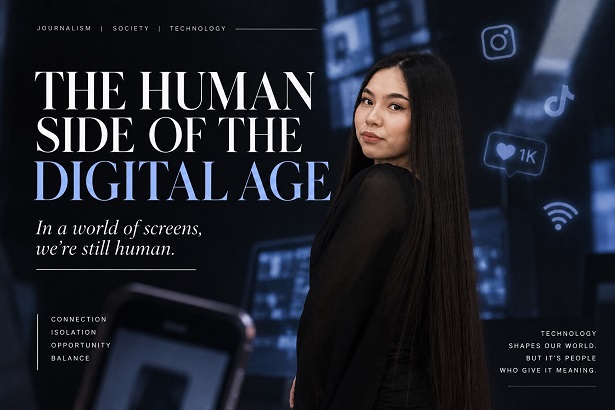
Why Being Real Matters More Than Being Online
By Araylym Uzakbay,
Scientific supervisor: assistent professor of Kazakh American University
Zhuasbaeva Aliya Tlegenovna
We live in a world where almost every moment can become content. A morning coffee, a university lecture, a trip with friends or even a difficult day can be photographed, edited and shared within seconds. Social media has made communication faster and the world feel smaller. Yet, behind the constant stream of posts, likes and short videos, an important question is emerging: are we becoming more connected, or simply more visible?
For many young people, being online is part of everyday life. Digital platforms help students discover opportunities, learn new skills, follow the news and express their opinions. A young journalist can publish an article without waiting for a traditional newspaper to accept it. An aspiring designer can show a portfolio to an international audience. A student from a small town can join an online course and communicate with people from different countries. In this sense, the digital world has opened doors that previous generations could hardly imagine.
However, the same platforms that create opportunities can also influence how people see themselves. Social media often presents life as a carefully selected collection of perfect moments. Users compare their ordinary days with someone else’s best photographs, achievements and celebrations. Over time, this comparison can create the feeling that everyone is moving forward while they are falling behind. Research on young people’s digital habits shows why it is important to discuss the balance between online activity and well-being (World Health Organization Regional Office for Europe, 2024).
Another challenge is the speed at which information travels. A dramatic headline or an emotional video can spread before anyone checks whether it is accurate. False information, manipulated images and misleading opinions can shape public discussions. For young people, especially those who get most of their news from social media platforms, media literacy is no longer an optional skill. It is a basic form of self-protection. Before sharing a post, we should ask: Who created it? What evidence supports it? Is the headline trying to inform me or provoke me? UNESCO emphasizes the importance of critical thinking and responsible engagement with media and information (UNESCO, 2021).
The answer is not to reject technology. Digital tools are part of modern education, journalism, business and culture, and they can make society more informed when used responsibly. The real task is to build a healthier relationship with technology. This may mean checking the source of a news story, turning off unnecessary notifications, taking breaks from scrolling or choosing to have an honest conversation instead of simply reacting to another post. The OECD also highlights the need for readers to distinguish facts from opinions and recognize misleading information in a digital environment (OECD, 2021).
We should also remember that authenticity is more valuable than a perfect online image. Real life includes uncertainty, mistakes, ordinary routines and moments that do not need an audience. Not every experience has to be recorded. Not every opinion needs to become a public statement. Sometimes, the most meaningful moments are those we experience fully, without thinking about how they will look on a screen.
For the younger generation, the digital age offers an extraordinary opportunities to create, learn and be heard. But opportunity comes with responsibility: to think critically, communicate respectfully and remember that there are real people behind the profiles. Technology can connect us across borders, but empathy is what makes that connection meaningful.
Perhaps the most important question is not how many hours we spend online, but what kind of people we become while using it. The future should not be a competition for attention. It should be a space where innovation supports human values, where information leads to understanding and where being real matters more than appearing perfect.
Keywords: digital culture, social media, young generation, media literacy, authenticity
REFERENCES
OECD. (2021). 21st-Century Readers: Developing Literacy Skills in a Digital World. OECD Publishing. https://doi.org/10.1787/a83d84cb-en
UNESCO. (2021). Media and Information Literate Citizens: Think Critically, Click Wisely! UNESCO. https://www.unesco.org/en/articles/media-and-information-literate-citizens
World Health Organization Regional Office for Europe. (2024, September 24). A focus on adolescent social media use and gaming in Europe, central Asia and Canada: Health Behaviour in School-aged Children international report from the 2021/2022 survey, Volume 6. https://www.who.int/europe/publications/i/item/9789289061322
Anderson, M., Vogels, E. A., Perrin, A., & Rainie, L. (2022, August 10). Teens, Social Media and Technology 2022. Pew Research Center. https://www.pewresearch.org/internet/2022/08/10/teens-social-media-and-technology-2022/